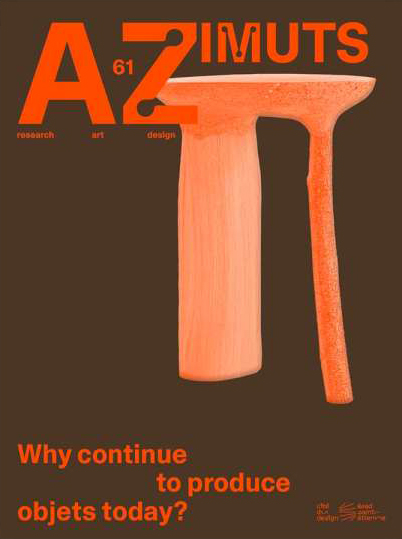
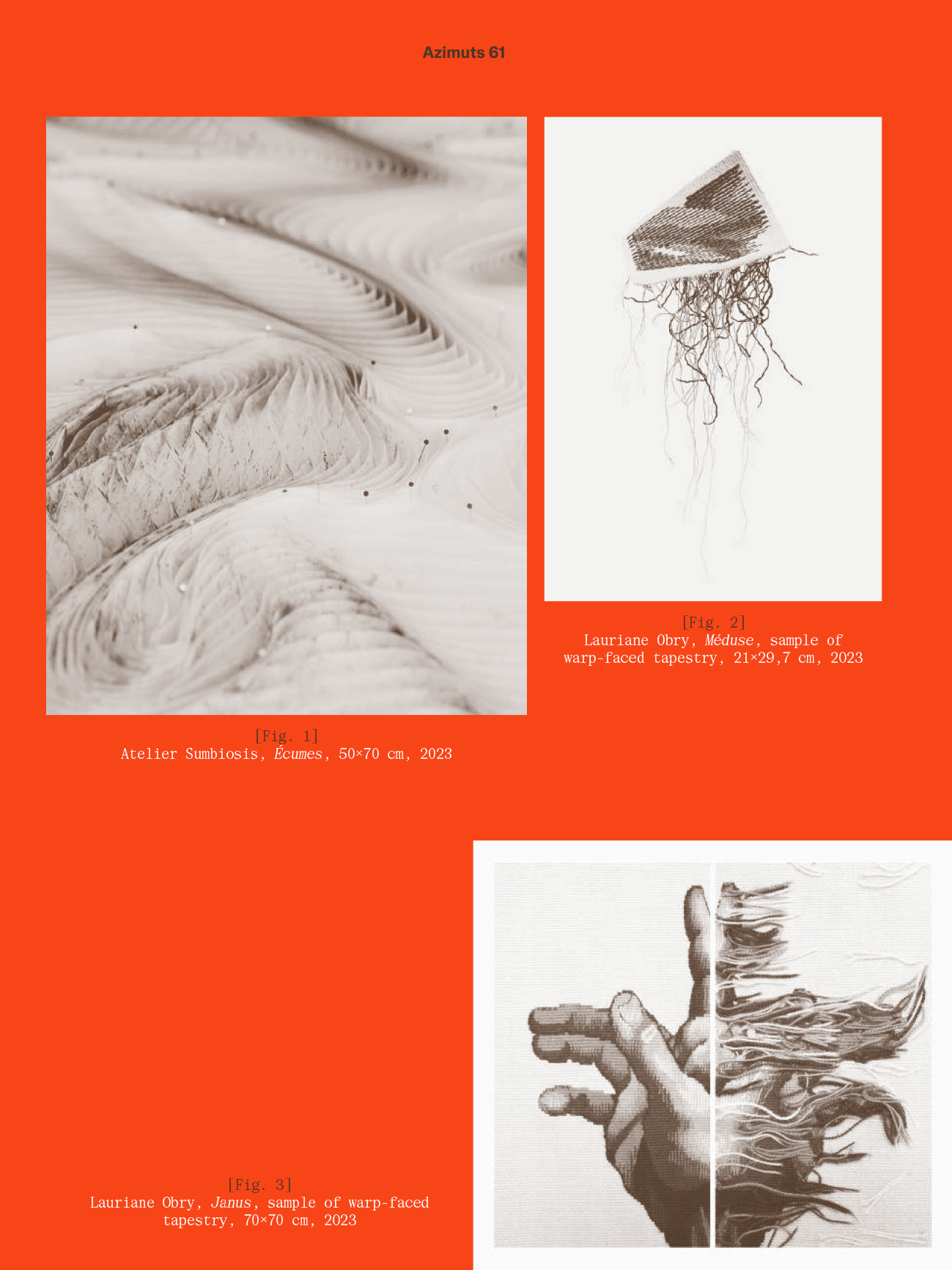
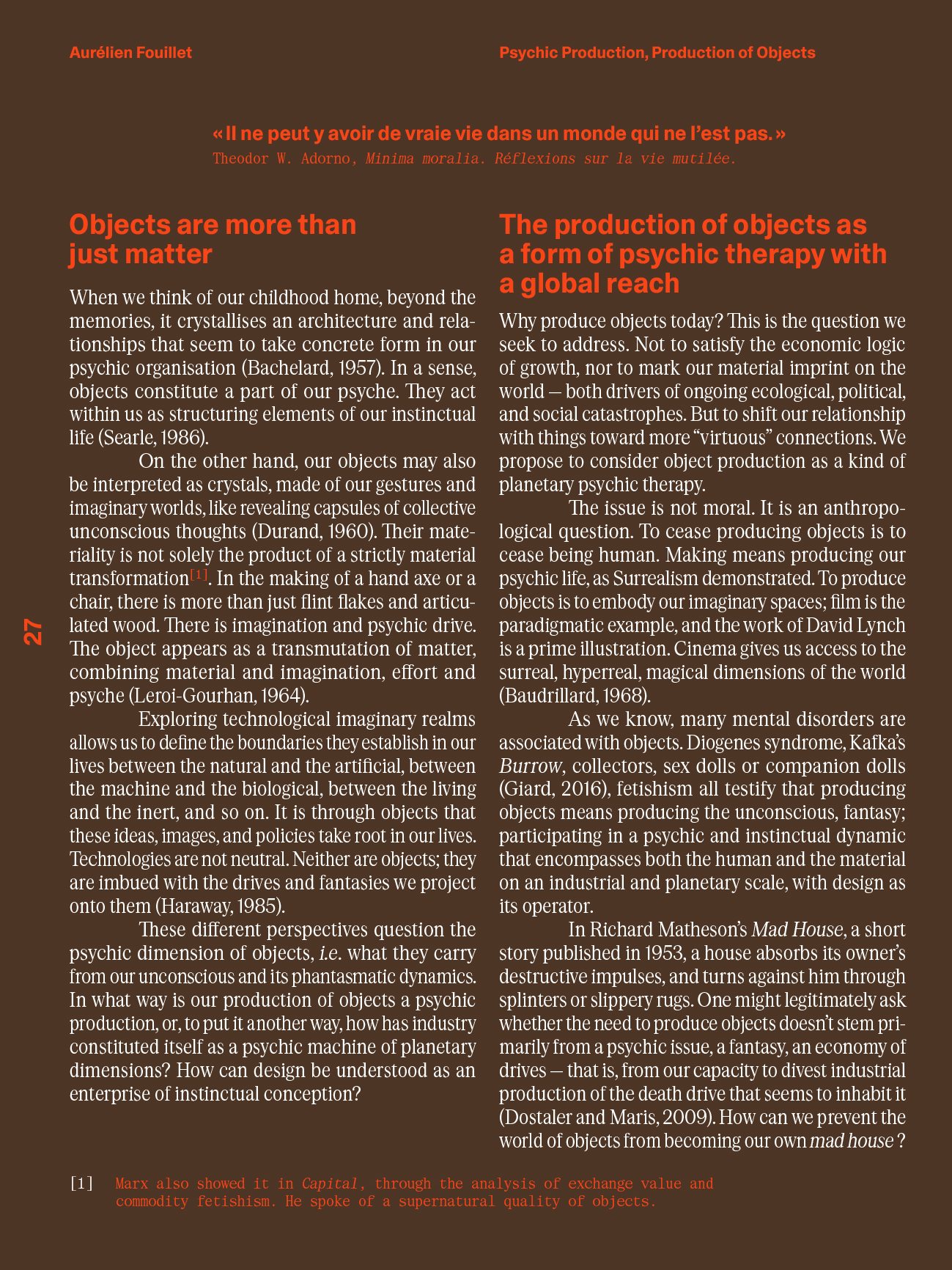
Why continue to produce objects today? In a world saturated with artifacts and facing ecological urgency, the very legitimacy of production seems to waver. Starting from this question, issue 61 of Azimuts brings together designers, researchers, artists, and students around contemporary object practices.
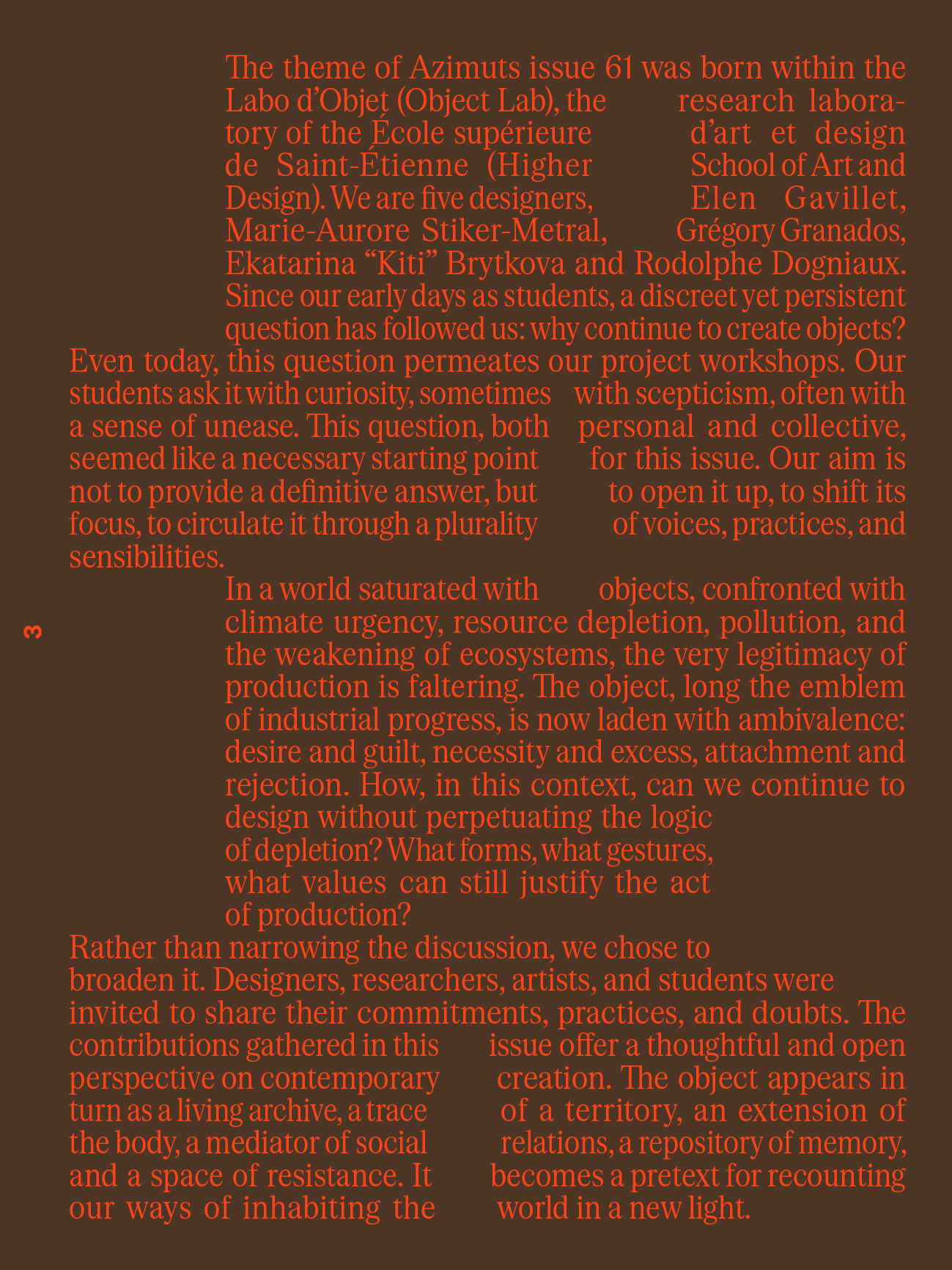
The theme of Azimuts issue 61 was born within the Labo d'Objet (Object Lab), the research laboratory of the École supérieure d'art et design de Saint-Étienne (Higher School of Art and Design). We are five designers, Elen Gavillet, Marie-Aurore Stiker-Metral, Grégory Granados, Ekatarina "Kiti" Brytkova and Rodolphe Dogniaux. Since our early days as students, a discreet yet persistent question has followed us: why continue to create objects?
Even today, this question permeates our project workshops. Our students ask it with curiosity, sometimes with scepticism, often with a sense of unease. This question, both personal and collective, seemed like a necessary starting point for this issue. Our aim is not to provide a definitive answer, but to open it up, to shift its focus, to circulate it through a plurality of voices, practices, and sensibilities.
In a world saturated with objects, confronted with climate urgency, resource depletion, pollution, and the weakening of ecosystems, the very legitimacy of production is faltering. The object, long the emblem of industrial progress, is now laden with ambivalence: desire and guilt, necessity and excess, attachment and rejection. How, in this context, can we continue to design without perpetuating the logic of depletion? What forms, what gestures, what values can still justify the act of production?
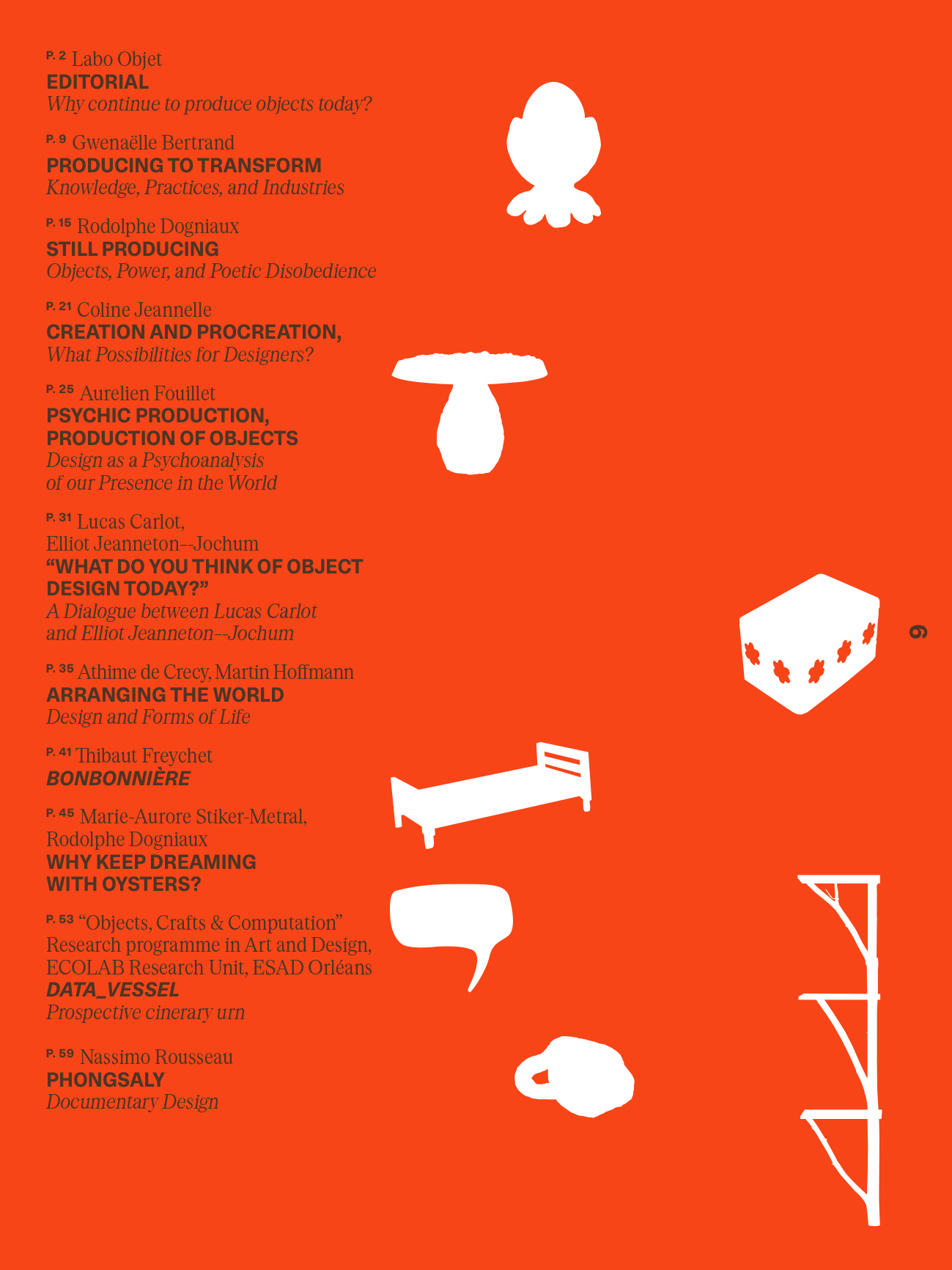
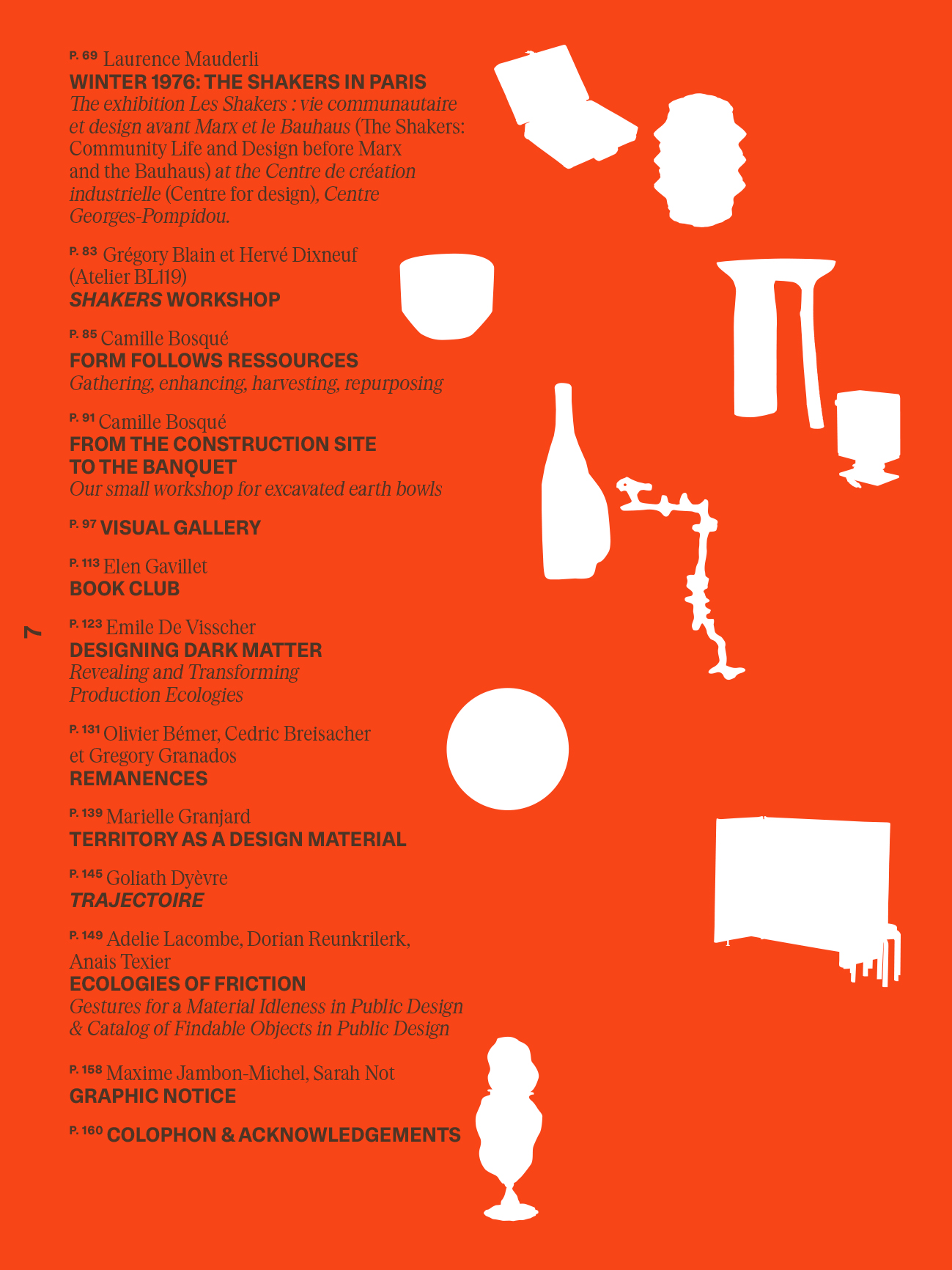
Rather than narrowing the discussion, we chose to broaden it. Designers, researchers, artists, and students were invited to share their commitments, practices, and doubts. The contributions gathered in this issue offer a thoughtful and open perspective on contemporary creation. The object appears in turn as a living archive, a trace of a territory, an extension of the body, a mediator of social relations, a repository of memory, and a space of resistance. It becomes a pretext for recounting our ways of inhabiting the world in a new light.
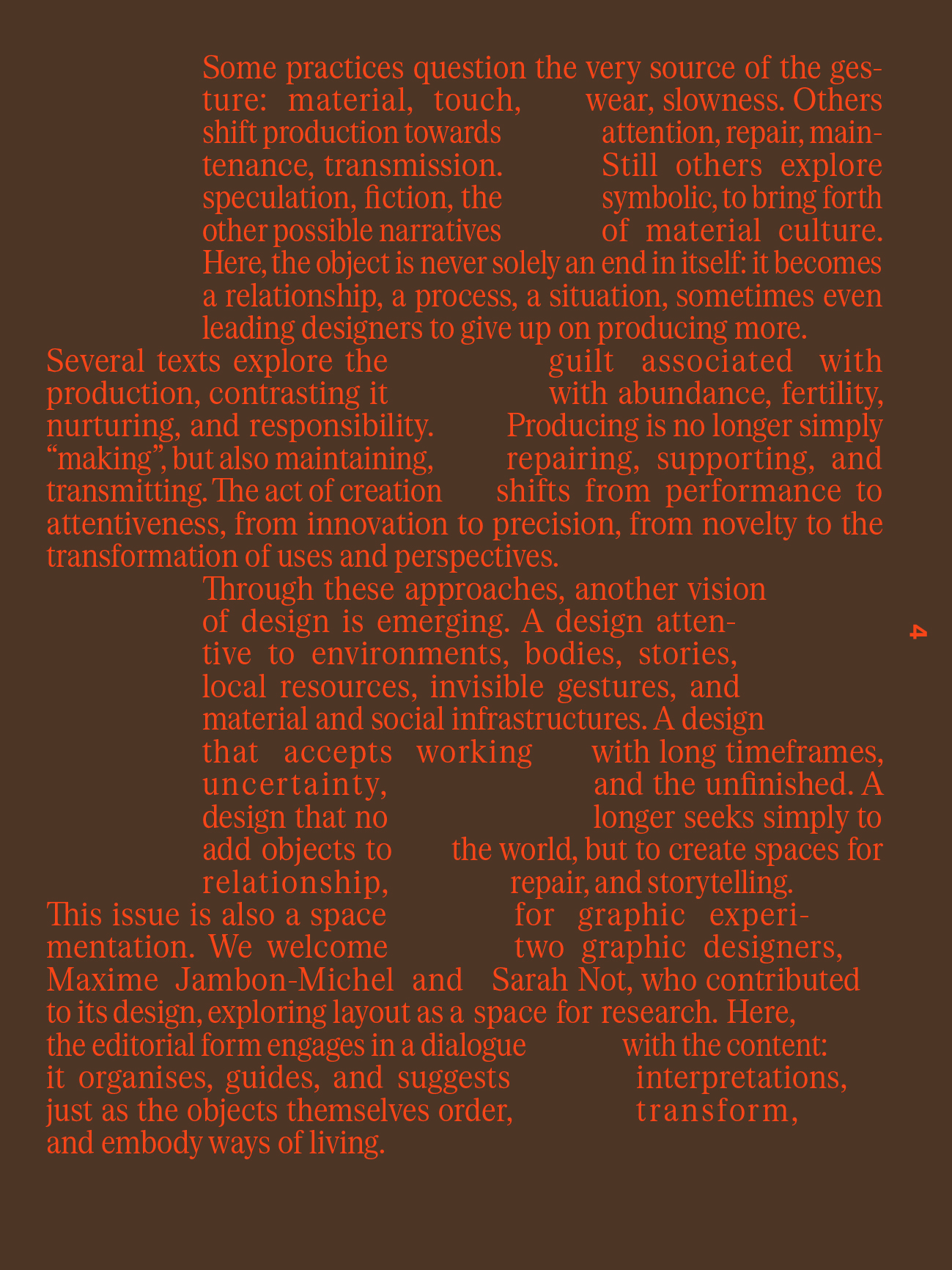
Some practices question the very source of the gesture: material, touch, wear, slowness. Others shift production towards attention, repair, maintenance, transmission. Still others explore speculation, fiction, the symbolic, to bring forth other possible narratives of material culture.
Here, the object is never solely an end in itself: it becomes a relationship, a process, a situation, sometimes even leading designers to give up on producing more.
Several texts explore the guilt associated with production, contrasting it with abundance, fertility, nurturing, and responsibility. Producing is no longer simply "making", but also maintaining, repairing, supporting, and transmitting. The act of creation shifts from performance to attentiveness, from innovation to precision, from novelty to the transformation of uses and perspectives.
Through these approaches, another vision of design is emerging. A design attentive to environments, bodies, stories, local resources, invisible gestures, and material and social infrastructures. A design that accepts working with long timeframes, uncertainty, and the unfinished. A design that no longer seeks simply to add objects to the world, but to create spaces for relationship, repair, and storytelling.
This issue is also a space for graphic experimentation. We welcome two graphic designers, Maxime Jambon-Michel and Sarah Not, who contributed to its design, exploring layout as a space for research. Here, the editorial form engages in a dialogue with the content: it organises, guides, and suggests interpretations, just as the objects themselves order, transform, and embody ways of living.
Producing objects today is therefore no longer simply an act of manufacture. It is a sensitive, political, critical, and reflective gesture. To produce is to invent relationships, to prolong the memory of a place or a material, to support uses, and sometimes to accept producing less in order to process more effectively. It is to experiment with other ways of making the world.
Through this issue, we are inviting the reader to come on board and participate in this open conversation, to explore the tensions, the doubts, but also the impulses that drive contemporary design practices.
In short, this 61st issue of Azimuts is an invitation to persevere, despite the excess, the urgency, and the contradictions.
It reminds us that creating objects is never simply about manufacturing: it is about reflecting, inventing, and bringing worlds into being. The question "Why produce more objects?" is not a passing doubt, but a critical driving force that engages the role of the designer, the place of objects in our lives, and the forms of creation that are both responsible and poetic. It is a call to design differently: consciously, with rigour, care, and sensitivity.
Azimuts is a design research journal founded in 1991 by the student-researchers of the post-graduate program of the École supérieure d'art et design de Saint-Étienne. A unique publication in the design editorial landscape, the journal is a place for reflection, exchange, and criticism on the issues of contemporary design and art, as well as a field for experimentation and graphic and typographic research. Azimuts magazine gathers the points of view of personalities from the world of design, culture and research in general. The issues are organized around thematic dossiers on design and, more generally, on material culture or its criticism. The "Varia" section welcomes contributions that are not part of the dossier, and the "Anthology" section allows readers to discover or rediscover texts and documents that are difficult to access (out of print or never translated into French). The "Reviews" section is a space for free criticism of current research and publications on design in the field.