Sur les formes de sabotage, d'insubordination et d'activité invisible qui échappent au domaine politique.
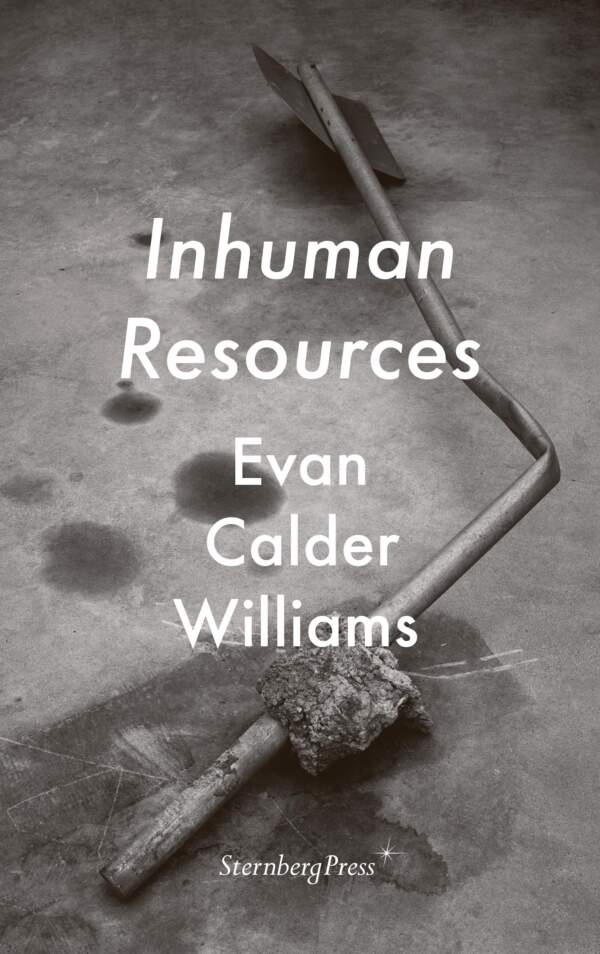
What gets stranded outside the borders of the political? Inhuman Resources develops an account of sabotage, insubordination, and the invisible activities that undermine the ideas of accountability and identifi cation on which representative politics rely.
Drawing from histories of labor, disability, infrastructure, writing, and war, Williams offers genealogies of the tropes of paralysis and sabotage, which leave behind notions of public citizenship to reveal an "inhuman" agency that hinges on the unexpected friction between humans, materials, machinery, and other non-human life. Yet to detect this and move away from fantasies of clarity and visibility, we need to take cues from political and artistic practices that evade such legibility, and are attuned to what happens off-screen and without recognition.
Spanning an ambitious range of subjects—from prison architecture to digital animation, legal history to self-help books, and electrical blackouts to silkworms saturated with toxic dye—Inhuman Resources gathers materials for thinking differently about insurgent activity. This is a theory that does not privilege exodus, pride, or autonomy but instead takes shape inside the very processes, architectures, appearances, and systems it seeks to ruin.
Evan Calder Williams (né en 1982 à Portland, Maine) est écrivain et artiste. Ses films, performances et œuvres audio ont été présentés dans des biennales, des institutions artistiques et des festivals de cinéma à travers le monde. Evan Calder Williams est par ailleurs professeur associé au Center for Curatorial Studies du Bard College. Il est l'auteur de plusieurs ouvrages (
Combined and Uneven Apocalypse ;
Roman Letters ;
Shard Cinema), le traducteur, avec David Fernbach, de
Towards a Gay Communism de Mario Mieli. Il est rédacteur en chef adjoint d'
e-flux journal, et ancien membre du collectif éditorial du magazine
Viewpoint.